
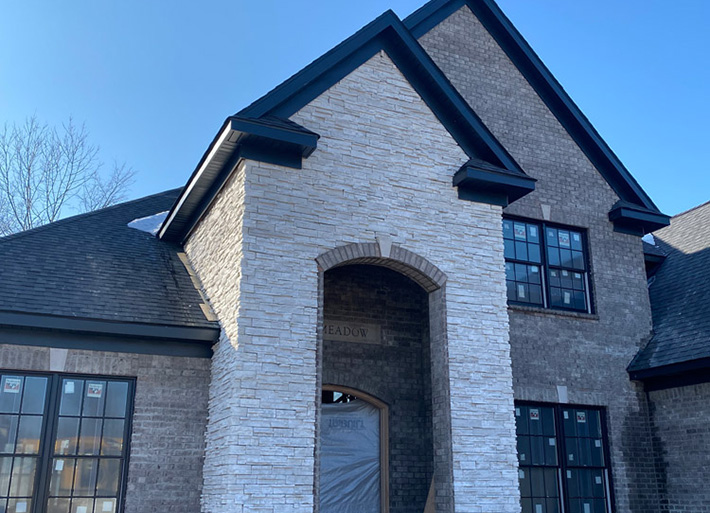
Brick arches can give a home character that a straight opening simply doesn’t. You may see them above front doors, garage openings, or older windows where the brick follows a shallow curve across the top.
Because an arch looks decorative, homeowners sometimes assume cracks around it are mainly cosmetic. The masonry around an opening is doing real work, though.
When mortar begins separating or individual bricks shift, the pattern can reveal movement that deserves attention.
Understanding how an arch is built helps explain why these problems develop.
An Arch Has To Move Weight Around The Opening
A brick wall above a window or door cannot simply rest in the space below it. That weight has to be carried to the masonry on either side.
A properly constructed arch helps divert those forces toward the surrounding wall. Some brick arches perform that structural role directly. Others are decorative and rely on concealed steel support.
Either arrangement depends on the nearby masonry remaining stable.
If the support changes or the mortar joints begin deteriorating, the arch may start showing the effects. Small cracks can develop near its ends, while individual bricks may gradually move out of their original position.
The Ends Of The Arch Matter More Than They Look
The masonry beside an arch resists the forces created by the brickwork above the opening.
That means damage near the ends of the arch can be significant.
If the surrounding wall moves outward slightly, the arch can lose some of the restraint it depends on. Cracking may begin close to the point where the curved masonry meets the straight wall.
This can happen slowly enough that the homeowner notices the mortar first. A joint may open a little more each year before any brick looks obviously displaced.
Repairing the visible joint without investigating the movement can leave the underlying problem unchanged.
Mortar Deterioration Can Let Bricks Shift
Older mortar does not last forever.
Rain and Michigan freeze cycles gradually wear exposed joints. Once mortar softens or begins to fall away, the bricks lose some of the support that keeps the arch working as a unit.
Water can then enter the damaged joints more easily. In cold weather, that moisture can freeze inside the masonry and add stress to already weakened areas.
The result may be a combination of open joints and bricks that no longer follow the first curve cleanly.
Repointing can be an appropriate repair when the bricks remain sound and the problem is limited to deteriorated mortar. More extensive movement requires a closer look before new mortar is installed.
A Steel Support Can Develop Problems Too
Not every brick arch carries its own load.
Some decorative arches are supported by steel hidden within the masonry. If that steel corrodes, rust can expand and begin pushing against nearby brick.
Homeowners may first notice a crack running through the mortar above the opening. The brickwork can also begin lifting or separating in the affected area.
This is similar to the problems that develop around rusting masonry lintels, although the details of an arched opening can make the repair different.
Simply filling the crack does not address expanding steel underneath it. The condition of the support needs to be evaluated first.
Movement Elsewhere Can Show Up Around An Arch
Openings are natural places for stress to appear because the brick wall is interrupted there.
If a section of the building settles or the surrounding masonry moves, the effects may become visible around a window or doorway before they are obvious elsewhere.
That does not mean every hairline crack points to a major structural problem. Masonry develops small cracks for many reasons.
What matters is the pattern and whether it is changing.
A crack that continues widening deserves more attention than one that has remained unchanged for years. Bricks beginning to separate from the surrounding wall are another reason to have the opening inspected.
Watch For Changes In The Shape Of The Opening
An arch that is beginning to move may no longer look symmetrical.
One side may appear slightly lower, or a mortar joint may widen more than the neighboring joints. In more advanced cases, individual bricks can begin projecting beyond the face of the wall.
Changes around the window or door itself may provide another clue. A frame that suddenly seems tighter than before can suggest movement around the opening, although the frame can also develop problems for unrelated reasons.
Comparing the masonry from season to season can help determine whether the condition is stable.
Good Repairs Address More Than The Crack
The right repair depends on what caused the arch to move.
Deteriorated mortar may need careful removal and replacement with an appropriate mortar. Damaged bricks may need to be removed individually. If the arch has lost structural support, portions of the masonry may need to be rebuilt so the opening can carry loads properly again.
Matching of the existing brick also matters on a feature as visible as an arch. Replacement masonry that differs sharply in size or appearance can leave a repair standing out around one of the most noticeable parts of the façade.
Cracked Brick Arches? Address the Cause Before the Damage Spreads
Brick arches can last for generations when the surrounding masonry remains sound. Once joints begin to open or bricks start shifting, delaying repairs can allow water intrusion and continued movement to cause more extensive damage.
Primo Contracting provides brick masonry repair and restoration throughout Rochester Hills and Southeast Michigan. From deteriorating mortar joints and damaged bricks to more involved masonry repairs around windows and doors, we focus on addressing the underlying problem while preserving the appearance and character of your home or structure.
If an arch above a window or door is cracking, separating, or starting to lose its original shape, contact us to schedule an evaluation and free estimate.