
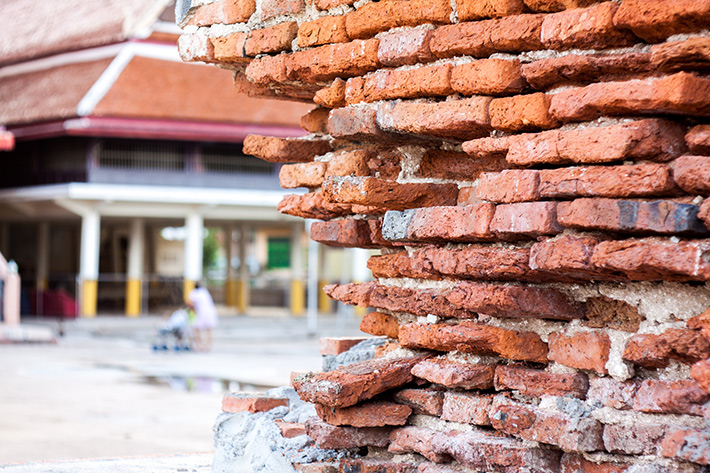
Michigan winters are tough on people, but they are just as hard on brick. One day, the temperature is below freezing, the next it is above, and that cycle repeats for months. Brick and mortar can handle a lot, but repeated freeze–thaw cycles push them to their limits.
Spalling, cracking, and loose bricks rarely appear overnight.
They usually start as small problems that grow with each season. Let’s look at what freeze–thaw damage really is, what spalling looks like up close, and how professional repairs and sealers help protect your brickwork.
How Freeze–Thaw Cycles Damage Brick and Mortar
Brick is durable but porous. It absorbs a small amount of water every time it rains or snow melts. When temperatures drop below freezing, that water inside the brick expands as it turns to ice. When it warms up again, the ice melts and contracts.
Every cycle puts stress on the brick surface and the mortar joints. Over time, that repeated expansion and contraction can cause:
● Fine surface cracks in the brick face
● Loose or crumbling mortar between bricks
● Separation between bricks and mortar
In Michigan and across the Midwest, where winter often swings between above- and below-freezing temperatures in the same week, this process can be relentless. Bricks near the ground, on exposed chimneys, and on steps that see a lot of snow and ice are especially vulnerable.
What Spalling Looks Like
Spalling is one of the most common and visible signs of freeze–thaw damage. It occurs when the brick’s surface begins to break away.
You might notice:
● The brick’s face is flaking or peeling.
● Pits or shallow holes in the surface
● Bricks that look “scaly” or rough where they used to be smooth
● Edges rounding off as material breaks away.
In advanced cases, the entire outer layer of a brick can pop off, exposing the inner core. That inner material is usually softer and more absorbent, so once it is exposed, the brick tends to deteriorate even faster.
Spalling is not just a cosmetic problem. As the brick loses material, it also loses strength. On a wall, that can mean a loss of support. On a chimney or set of steps, it can become a safety hazard.
Where You See Freeze–Thaw Damage First
Some parts of a building see more moisture and temperature stress than others. Common trouble spots include:
● Chimneys that stand above the roof and take full weather exposure
● Brick steps, porches, and walkways that collect snow and ice
● Lower courses of brick near the grade, where splash-back and snow pile up
● Parapet walls and exposed corners that see more wind and water
If you walk around your property at the end of winter and look closely at these areas, you can often spot early signs of damage.
Catching these issues early makes repairs more manageable and less expensive.
How Professional Masonry Repairs Help
The most effective solution is targeted repair by an experienced masonry contractor. Applying a surface sealer to damaged brick will not fix the underlying problem.
Typical professional repairs may include:
● Removing and replacing damaged bricks: Spalled or cracked units are carefully cut out and swapped with new bricks that match in size and appearance.
● Repointing mortar joints: Deteriorated mortar is removed to a precise depth and replaced with fresh mortar that suits the brick and local climate.
● Addressing related issues: If water is entering from failing flashing, missing caps, or poor drainage, those causes are corrected so the damage does not return.
Sealers and water repellents can be powerful tools against freeze–thaw damage when used correctly. The key is choosing products designed for brick and having them applied by professionals who understand how they interact with masonry.
A good masonry water repellent will:
● Reduce water absorption at the surface.
● Allow the brick to breathe and release moisture from within.
● Help keep salt and de-icing chemicals from penetrating as deeply.
What you want to avoid is a heavy, non-breathable coating that traps moisture inside the brick. That can actually make freeze–thaw damage worse.
Before applying any sealer, a qualified contractor will typically:
● Clean the brick to remove dirt, efflorescence, and loose material.
● Repair major cracks and bad joints.
● Confirm that the wall, chimney, or steps are structurally sound.
Sealers work best as part of a larger protection plan, not as a shortcut around needed masonry repairs.
Protecting Your Brickwork for the Long Term
If you have noticed flaking brick faces, crumbling mortar, or loose steps around your property, it may be time to bring in a professional. Primo Contracting in Rochester Hills offers full-service brick masonry repair, restoration, and new construction, along with chimney work, porches, retaining walls, and other custom projects. Their team can assess the condition of your brickwork, recommend the right repairs, and help protect your masonry so it stays strong through many more freeze–thaw seasons.