
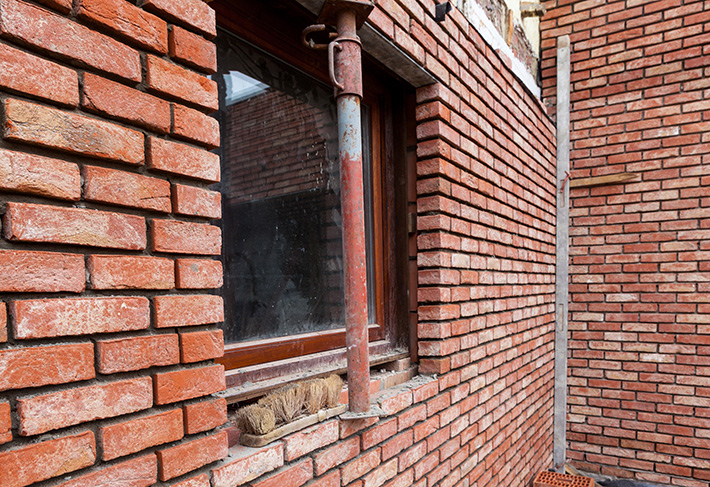
Cracks above a window or door have a way of getting your attention. They often start as a thin stair step in the mortar, then widen over a season or two. Sometimes the brick above the opening appears to be lifting slightly. Sometimes the paint on the inside wall near that window starts to show faint staining after heavy rain.
Homeowners usually assume the house is settling. Settling does happen, but one of the most common causes of these “over-the-opening” cracks in the brick is simpler: a rusting steel lintel.
Rusting brick lintels: why cracks form and what to do about them
A lintel is the piece that carries the weight of the brick above an opening, such as a window, door, or garage. In brick-veneer construction, the lintel is often a steel angle. It sits above the opening, supports the brick, and transfers the load to the masonry on either side.
Steel works well for this until it starts rusting. Rust takes up more space than the original steel. As the metal expands, it pushes outward and upward on the masonry around it. This is sometimes called rust jacking. The brick-and-mortar cannot flex much, so it cracks. Over time, the pressure can also distort the angle itself.
The telltale signs that it is a lintel issue
You do not need to be a mason to spot the patterns. A few clues tend to show up together:
● Cracks that start near the corners of a window or door and run outward in a stair-step pattern.
● A small gap that appears between the steel and the brick, or a line of rust staining along the mortar joint above the opening.
● Brick that looks slightly lifted or separated above the opening.
● Cracks that get worse after wet seasons, especially in climates with repeated freeze-thaw cycles.
If you see orange staining, that is often the giveaway. Water is reaching the steel, the steel is corroding, and the rust is telegraphing through the mortar.
Why do lintels rust in the first place?
Steel does not rust without moisture. Most lintel problems come down to water management.
Brick gets wet. That is normal. The wall is supposed to handle it by shedding water and draining. When flashing, end dams, or weep paths are missing or malfunctioning, moisture can linger near the lintel.
Repeated wetting and drying also pull salts through the masonry, which can accelerate corrosion.
Michigan-style weather adds another layer. When a wet section freezes, water expands. Mortar joints open slightly, then more water gets in. It becomes a cycle. The steel does not need to be fully soaked for years. Even repeated small exposures can start the rust and expansion process.
Why a quick patch often fails
A common DIY response is to caulk cracks or smear mortar over damaged joints. This may improve appearance briefly, but does not address the cause. If rusting steel continues to expand, the crack often returns and widens.
Painting the lintel can also be misleading. If the steel is already scaling or delaminating due to rust, paint becomes a cosmetic layer over an ongoing problem. The underlying metal continues to expand, and the masonry keeps cracking.
What a proper repair looks like
The right repair depends on how far the lintel has deteriorated and what caused the water exposure in the first place. Identifying a “safe harbor” means assessing when repairs can be made without compromising the building’s stability. Ensuring the area is structurally stable before starting work is critical for safety.
In many cases, a complete repair involves:
1. Evaluating the steel condition
If the lintel is still structurally sound and the rust is mostly surface-level, it may be cleaned and protected. If it has lost thickness, warped, or is pushing the brick significantly, replacement is often the safer choice.
2. Addressing the moisture path
This is the part that separates a lasting repair from a repeat repair. If the flashing is missing or compromised, it needs attention. If the wall cannot drain, the steel will keep getting wet. This is also where detailing at the ends of the lintel matters. Water tends to collect at edges and corners.
3. Resetting or replacing masonry as needed
Damaged brick and mortar around the opening may need to be removed and rebuilt. This is not just for appearance. It restores proper bearing and alignment so the load is carried correctly.
4. Protecting the lintel
A properly prepped and coated lintel stands up better over time. The goal is to slow future corrosion, especially at exposed edges.
A good masonry contractor will also look for related issues around the opening. If the sill is letting water into the wall, or if caulk joints are failing, those details can keep feeding moisture to the same area.
What happens if you ignore it
Lintel cracks rarely stay the same. The wall continues moving in tiny increments as rust expands and seasons cycle. Over time, you can see:
● Wider cracking and more displaced brick.
● Loose brick at the opening corners.
● Increased water entry, especially if the mortar joints open up.
● More expensive repairs because more masonry needs rebuilding.
This is one of those problems where early work is usually smaller work. Catch it when the cracking is light and the steel is still in decent shape; repairs tend to be more straightforward.
A practical next step
If you are seeing cracks over windows or doors, or rust staining along the steel, it is worth having the lintel and surrounding water management details evaluated together. A repair that only addresses the crack is often temporary. A repair that addresses the steel and the moisture source is the one that holds.
Brick Masonry Services That Stand the Test of Time
Keep your custom brick structures stunning and standing for decades with the expert masonry services of Primo Contracting in Rochester Hills. We address everything from brick repair and custom masonry projects to new construction, remodeling and more.
We are a preferred contractor for brick masonry and general contracting for residential and commercial properties, with a commitment to craftsmanship, durability, and lasting value. If you want to get the most from your construction investment, trust our masonry and contracting services to deliver results that stand the test of time throughout Rochester Hills and the Metro Detroit area.